
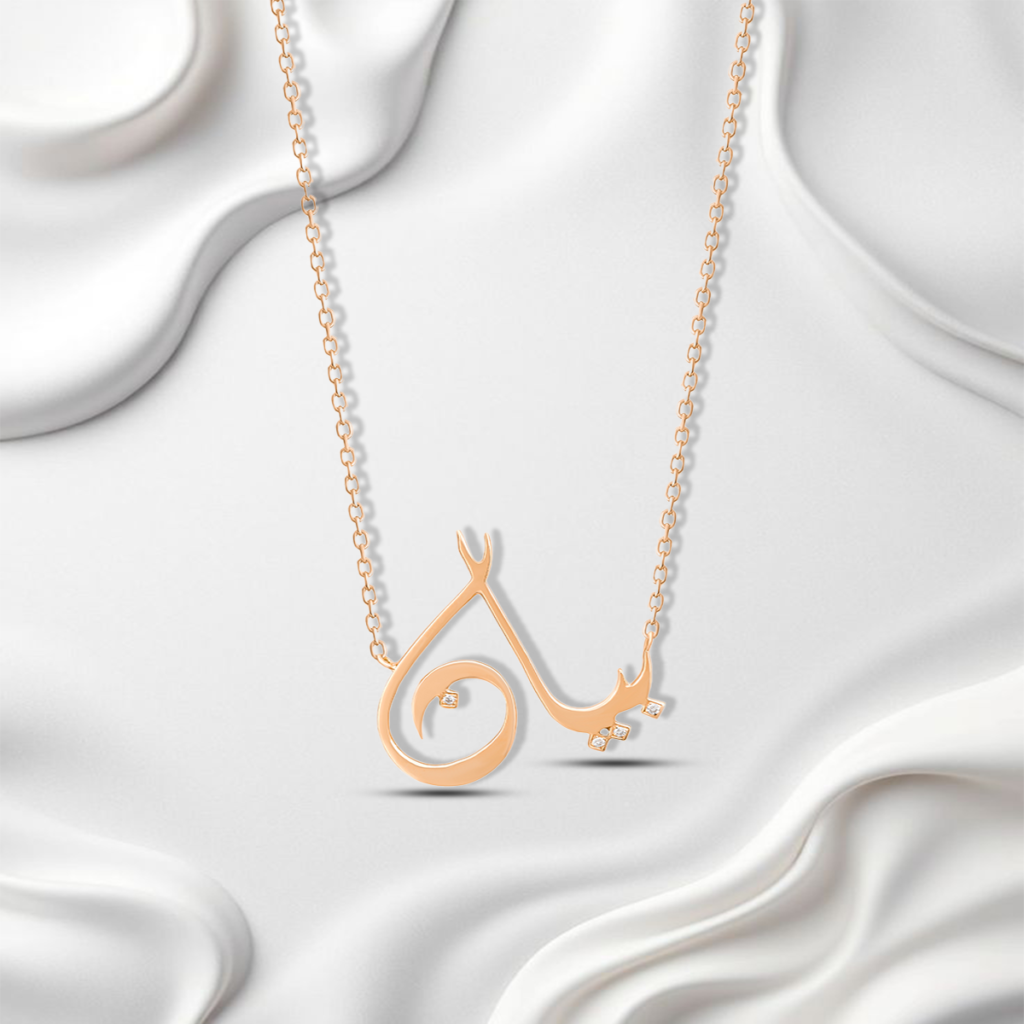
Walk anywhere in Dubai and you’ll see words carrying weight: Qur’anic verses etched into mosques, poetry woven through museum façades, signage that pairs Arabic with dozens of other languages. In this dense fabric of scripts, Arabic calligraphy jewelry Dubai collectors choose becomes a way to carry the city’s multilingual heartbeat on the body. For Essmi Jewellery, calligraphy isn’t decoration, it’s urban culture condensed into a precious form.
A City of Many Tongues, One Visual Rhythm
Dubai’s public spaces speak in multiple alphabets, yet Arabic sets the rhythm. Its flowing geometry is a visual constant from Deira’s traditional souqs to the galleries of Alserkal Avenue. When that rhythm transfers into jewelry, it does something subtle: it reconciles contrasts. Residents who grew up elsewhere adopt a local visual language; Emiratis translate family heritage into contemporary signatures; visitors take home a wearable memory that isn’t a cliché skyline charm.
This is why calligraphy jewelry here feels different from other cities. It doesn’t merely say a name; it says “I belong to this conversation,” the ongoing dialogue between heritage and hyper-modernity that defines Dubai.
The Script as Architecture You Can Wear
Think of Dubai’s skyline: strong verticals, sweeping arcs, structural daring. Arabic scripts mirror those moves at a smaller scale:
- Kufic acts like a facade grid, orthogonal, modular, perfect for strong silhouettes.
- Thuluth echoes the city’s curved highways and dune lines, expansive and theatrical.
- Diwani resembles the intimate courtyards of old neighborhoods, tight, ornate, inwardly focused.
At Essmi Jewellery, we design calligraphy as micro-architecture. Stroke thickness equates to load-bearing walls; counters (the hollow spaces inside letters) operate like courtyards that invite light; letter connections behave like cantilevers. The result isn’t a charm with letters on it, it’s structure with meaning.
Beyond Personalization: Belonging
Personalized jewelry is global; belonging is local. In Dubai, a pendant inscribed with a virtue, sabr (patience), karam (generosity), himma (aspiration), isn’t a trend piece. It’s a social contract. It reflects how people here value ambition without losing grace, speed without losing courtesy. Even when customers request non-Arabic names, many ask Essmi to render them in Arabic letterforms. The goal isn’t translation; it’s integration, letting one’s story find a home in the host script.
The Diaspora Thread
Dubai’s population is majority expatriate, and calligraphy jewelry often becomes a bridge back to a first language or forward to a future identity. We’ve seen three recurring narratives:
- Relearning: Adults who once read Arabic in school reconnect through a single daily word worn at the neck.
- Passing on: Parents commission pieces that spark questions from children, “What does that mean?”, turning a necklace into a language lesson.
- Hybridization: Couples from different linguistic backgrounds choose a shared word, salaam, rahma, amal, as a wearable emblem of their blended life.
For each scenario, Arabic calligraphy jewelry Dubai wearers choose is not about ornamentation; it’s cultural continuity in motion.
Ethics of Words
Words carry responsibility. We often work with messages that require sensitivity, religious lines, names of loved ones, even fragments of poetry. Essmi Jewellery encourages thoughtful placement: how a word touches skin, how it will be read by others, and how the wearer’s daily life, workplace, travel, social contexts, might shape interpretation.
This respect for text is part of the craft. It means considering how a verse should be arranged to maintain dignity, how a blessing should be oriented, and when minimalism is more appropriate than spectacle. In Dubai’s cosmopolitan setting, this ethical design stance matters.
Process as Cultural Dialogue
The making of calligraphy jewelry is a conversation between the scribe’s discipline and the jeweler’s constraints. Our design process at Essmi deliberately mirrors Dubai’s creative ecosystem:
- Script Consultation: We begin with letterform logic, balance, contrast, and the historic rules that keep a script authentic.
- Parametric Drafting: Digital tools map weight, counter-space, and curvature so legibility survives scaling down to finger-width or pendant size.
- Tactile Prototyping: We 3D model for proportion, then prototype to test how the piece “reads” in real light, sunlight off Sheikh Zayed Road is harsher than gallery light in Alserkal.
- Community Feedback: Clients often bring family or friends; their input becomes part of the piece’s cultural life before it even leaves the studio.
Each step acknowledges that in Dubai, culture is collaborative, built as much in majlis conversations and studio critiques as in final showcases.
The Dubai Day/Night Effect
The city has two personalities: bright, reflective days and luminous nights. We design calligraphy to perform across both. Daylight demands clarity: negative spaces must stay open; letter connections must be read at a glance. Night life calls for presence: forms should catch ambient glow from restaurants, waterfronts, and art events. This duality shapes our decisions on stroke rhythm, cutouts, and the way letters “breathe.”
Minimalism with Memory
Dubai’s taste tends toward refined restraint, clean lines that still carry story. That’s why many of our commissions compress meaning into a single gestural move: the elongation of a noon tail to echo a dune; a squared-off kaf that nods to Kufic inscriptions seen at museums; a ligature that recalls the curve of an abra on the Creek. These micro-citations quietly situate a piece within the city’s visual archive without becoming literal.
Public Culture, Private Resonance
Dubai invests in design, architecture festivals, museum openings, calligraphy exhibitions. Jewelry lets you participate in that public culture privately. A pendant worn under a shirt during a board meeting might be revealed at a family dinner; a ring that looks abstract to most becomes legible to someone who shares your language. The intimacy of recognition, someone catching the script and smiling, is a social thread unique to calligraphy.
Sustainability of Meaning
Trends move quickly in a city that loves the future. Words move slower. That’s their power. A single concept, aman (safety), noor (light), ikhlas (sincerity), can stay relevant through job changes, new neighborhoods, and shifting aesthetics. At Essmi Jewellery we design with that longevity of meaning in mind. The form can evolve; the idea remains.
Commissioning with Intent
When you approach Essmi to create Arabic calligraphy jewelry Dubai audiences won’t mistake for mass-market, we’ll ask questions that are cultural, not just visual:
- What context will this word live in, work, family, ritual?
- Which tradition do you want to echo, historic scripts, contemporary letter art, or a hybrid?
- How should the piece be read, instantly by everyone, or only by those who look closely?
- What memory should the form reference, an old city, a new beginning, a line of poetry?
These prompts shape a piece that fits Dubai’s cultural tempo rather than floating above it.
Essmi Jewellery’s Promise
We see ourselves less as a brand and more as stewards of letterforms. Every commission is a chance to let language act, not just as a message but as structure, place, and memory. In Dubai, where cultures intersect at speed, calligraphy jewelry offers a rare kind of stillness: a steady line you carry through the day that reminds you who you are and where you’re going.